Monday, August 22, 2016

Crabgrass

As the topic has come up recently it's time to discuss crabgrass on the course this year, specifically on tees.

For starters, it's my 9th season here and in that time I have made a pre-emergent application for crabgrass on tees only in the years for 2013-2015. In 2008-2012 we weren't able to do this for various reasons but we added this as we tried to change our tee management practices. In those years ('08-'12) I had seen zero to minimal crabgrass breakthrough. In creating a plan and budget for 2016, I made a decision to forego the application with the thought that it wouldn't be any worse than '08-'12 and use those resources elsewhere. Hindsight is always 20/20 and now I know. The application was probably a waste of resources in most mild years but this is no mild year. More on that below...

It had been a near-historic year for crabgrass in Chicagoland with the perfect storm of favorable weather. An early spring warmup, followed by hot and dry temps that gave the existing turf a stressful start to summer. Next came the rains and the crabgrass took off. The soil temperatures have hovered around 80 degrees for a couple months and to put that in perspective the 2015 season never exceeded 75 degrees and that was short lived. Those are prime conditions for crabgrass, as well as bare soil like you have in par 3 tees or holes that irons are used frequently. I have seen/heard a number of conversations about the disease and weed pressure this year and the theme is that 2016 is a year to remember (or forget). I ran a poll on Twitter reaching out to colleagues in Chicagoland and the Midwest to gauge crabgrass pressure this year. Most agree that it's been a difficult year for crabgrass, even for those that applied a pre-emergent. As of the time of this post, nearly 85% of those who responded said they had moderate to heavy crabgrass infestations and some have personally told me that they have breakthrough despite applying a pre-emergent in the spring.  


At this point it's best to talk about where we go from here and not dwell on the past. Crabgrass is tough and gets stronger as it ages. It's also difficult and tricky to get rid of where there is bentgrass seed/seedlings involved. We are looking at options for curative applications but at this point in the year it might be best for us to wait for first frost. Crabgrass will die at the first frost and we can begin doing some aggressive seeding and plan for a pre-emergent application for spring of 2017.

Wednesday, March 16, 2016

Course Opening Update:

Course Opening Update:

Spring has sprung early this year and the Turf Care Department are beginning the process of course clean-up and preparing the course for play.  Most of the greens fared well over the winter but there are signs of stressed Poa annua.  This is mainly due to low temperature injury, despite the fact it was generally a warmer fall/winter.  The extended fall and warm start to the winter prevented the turf from truly hardening off and preparing for the coming cold.  The ridges and mounds on the sunniest greens became exposed during one of the melt events and the turf that was not prepared for winter was subjected to sub-zero temps.  Most of this is superficial and will recover once warmer weather becomes more consistent but we have taken steps to speed the recovery process.  Affected greens have been aerified, verticut, seeded and the four worst greens were covered with tarps. 


All this means that greens will be unavailable for the immediate future.  We are asking members to avoid the greens for a short time. It is a small sacrifice to ensure they are in the best condition possible for the bulk of our season.  I anticipate greens to be open by April 1st, but it may be sooner than that.  For now temporary greens are in play.  Cart availability is evaluated on a daily basis.  The course was drying out fine but we have received nearly 1.5" of rain between March 13th - 16th and that will set us back from allowing carts out on the course. 

There are still lots of spring clean-up items to be checked off the list.  We will begin the process of removing sticks and debris, rebuilding bunkers and putting out accessories (rakes, tee markers etc.).  The goal would be to have all of these done before April 1, but if we open before keep in mind its a work in progress and we will continue to chip away at it daily.  

Thanks,

Wednesday, November 20, 2013

Winter Prep/Temp Greens

As we inch closer to the end of the 2013 season, we are putting the final touches on winter preparation for the course.  The irrigation system has been winterized and all plant protectants have been applied to playing surfaces.  Still, there are a few jobs remaining such as blowing and mulching the last of the leaves, bringing in the last of the amenities (rakes, tee markers, garbage cans etc.) and finally a winter blanket of sand topdressing for the greens.

Winter topdressing is a common practice at many northern courses but it has been done sparingly at BVGC in the past. Adding a heavy layer of sand to the greens just prior to snowfall or ground-freeze helps protect the crowns of the plant (growing points) for winter winds and can aid in thatch management and spring green-up.  Greens with shade and Poa annua (the two go hand-in-hand) are generally more susceptible to winter damage.  The use of protective tarp-style permeable turf covers can also accomplish this and more but: 1)are very expensive and labor intensive and 2)encourages Poa growth.  We will still be putting out the new turf covers we purchased this spring on holes 5 and 13 because they have a much higher population of Poa (70%) than the other greens and at this point, we need to ensure the plants survival even if it is encouraging the weaker grass species.


The downside to all of this is that all greens surfaces will be closed starting tomorrow, 11/21/13.  We will be placing temporary pins in approaches and near greens with the exception of all the par-3 holes.  There is limited room on all the par-3's due to water features or sand traps to place a temporary pin location.  All surfaces will be sanded and 5&13 will be tarped starting tomorrow.  At that time, we kindly ask that you do not hit to or walk on the putting surfaces for the remainder of the winter. We understand that the decision to put limits on where, when and how you use the golf course can be a sensitive one, especially since this is such a "new" process at BVGC but the benefits of turf health and better playing conditions outweigh the drawbacks of winter play on the greens.

Thank you for understanding.  As always if you have any questions please contact the golf shop or myself directly.  See you in 2014!

Friday, May 17, 2013

Crown Hydration and Winterkill

Let's talk about the current state of some of the greens here at BVGC. Some of the greens here experienced various areas of winterkill (more specifically crown hydration injury) over the late winter. Crown hydration is a situation where an extremely wet and snowy winter (especially late) combined with frequent warm-ups and re-freezing causes turf injury. The grass plants begin to take up water as the winter ends and the snow melts, but if cold temps and refreezing occurs the water will form ice crystals inside the plant and rupture it (i.e. blow it up from the inside). Annual Bluegrass (Poa annua) is especially susceptible to crown hydration injury.  Making things worse is the fact that shade enhances the problem: 1)more shade generally means more Poa and therefore a more susceptible grass species 2)more shade means slower snow melt and therefore more likely to have crown hydration injury due to refreezing.  

On to the factors that are specific to the greens and the crown hydration injury here at BVGC...First, we need to revisit the weather that was specific to Woodstock, not Ohare and not some lakeside Northshore club.  Reports of winterkill are numerous in central and southern Wisconsin.  The winter came late but came with a fury.  We received nearly 2" of rain on the last two days of January, followed by a rapid freeze.  This caused a layer of 6-8" of ice to accumulate on the green surfaces.  Prolonged ice cover can itself damage the turf, but it slows the melt process and enhances crown hydration injury.  From February 1 through late March we had several large snowfall events until things started to thaw towards the end of March.  I knew the prolonged ice and snow cover was going to be a concern and the staff on hand attempted to remove snow from several greens in mid-March to try to speed up the melt process.  It may have helped but ultimately damage has occurred on many greens here.  

Tuesday, February 19, 2013

Tweet Tweet

Wednesday, January 9, 2013

Miller

It is with heavy heart that I write this, but my beloved companion Miller known and loved by all here at BVGC passed away on January 4th.  He lived a great and enviable life, one where he was the star of the show at three golf courses and my companion for all but the first 8 weeks of his life.  He was the smartest, calmest and most well behaved dog I could ever ask for.  Miller was nearly 12 yrs old and was really in good spirits through the summer, but was diagnosed with lymphatic cancer in November and went downhill fast after that point. I knew he could not live forever and I did not want to see him suffer, so he was peacefully put down knowing that the last thing he saw was his good friend of all those years...You will never be forgotten. 


Enjoy the great goose chase in the sky!  

Tuesday, December 18, 2012

Tree Trimming

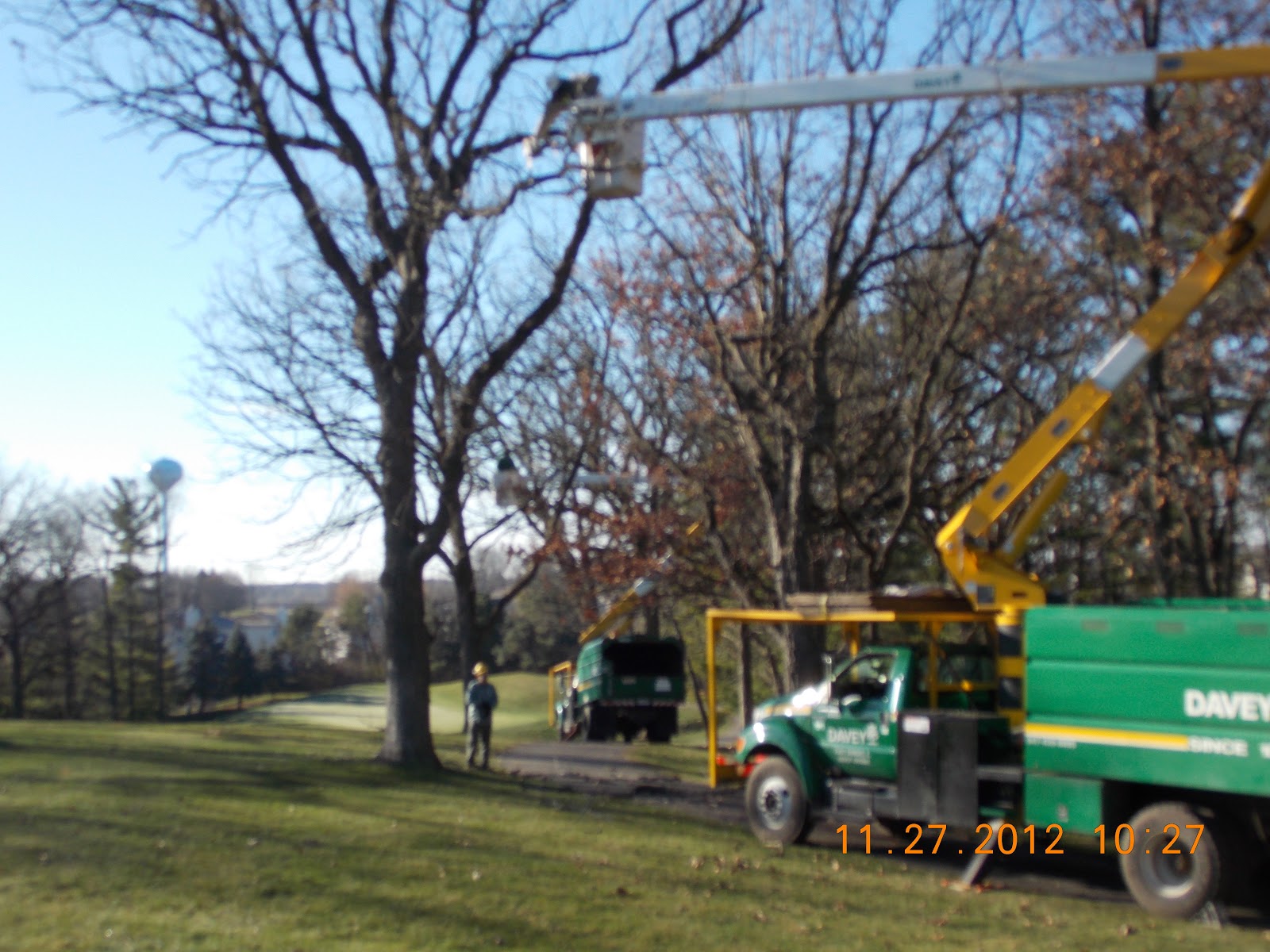
We had Davey Tree out for three days to help prune, trim and thin most of the oak trees on the course.  When done by tree experts removing dead wood and thinning out will help extend the life of the trees and make them safer for members and staff to play and work around.  We had originally planned for this to be done in March, but with the way the spring on came so early we missed our window as oaks should only be pruned before they leaf out or after they drop leaves.  

A good pruning should last 5-7 years for most of our tree species.  We plan to make yearly pruning and thinning a priority and we hope to cover 15-20% of our trees in one season.  Such a schedule will allow us to go through our entire tree inventory in that 5-7 year time frame, after which it will be time to start the cycle over again. We started with the oaks (and a few Hickory trees) as they are the most important specimens we have in terms of size, age, their visual impact on the hole and the way they affect how the hole is played. 


Friday, November 30, 2012

Late Fall Work

Some of the projects we wanted to get into this fall centered around restoring the native prairie areas of the course that have become overgrown with brush.  A month of frosty mornings has allowed us to clear out one of the largest and most infested areas of the course: the area between #7 green, #8 and #9 tee.


Here are some before shots...


Thursday, November 8, 2012

Irrigation Winterization

Today we begin the process of blowing out all the water from the irrigation lines using compressed air.  It's one of the major tasks we HAVE to complete before the snow flies and is one of the last few mile-markers we pass signifying the end of the 2012 golf season.  

We actually began the process over the preceding 3 days by shutting off the pumps and opening select valves to drain down the excess water as much as possible before the compressor arrived.  We move the compressor to various zones on the course and blow air section by section as we lack a large connection or inlet in or around the pump station that most courses possess. We hope to complete this task by Monday.


Friday, November 2, 2012

Preparing for Winter

As winter approaches, we are beginning the process of winterization.  Today marks the end of on-course restrooms as they are being cleaned and winterized for the coming months.  Next week, we are blowing out the lines for the irrigation system and we will begin to bring in items for storage such as ball washers, tee markers, bunker rakes, sand and seed boxes etc.  

Tuesday, October 30, 2012

Greens Nursery II

Even with the cooler temps we have gotten some nice germination thanks to the use of the greens cover.  This helps to trap the heat in and speed up germination and establishment.  We will keep the cover on all winter and be mowing in the spring.  Hopefully, we can use this for plugs and greens repairs by late summer or early fall 2013. 


Thursday, October 25, 2012

Rules are rules...

Cart restrictions are sometimes put into place to protect the unsuspecting player from entering wet or water-logged turf and causing damage.  It's no fun to call the golf shop and tell them there are cart restrictions for the day but believe me, they are put in place for a reason. 


These are pictures from today (10/25/12) on hole #4.  This time of year on #4 fairway, the angle of the sun has dropped so much that the tree line shades out the left side for nearly the entire day.  This makes small rain events last a long time in certain spots on the course.  I let carts off the paths the last two days with the exception of a few holes (#4 included) and placed ropes and signage in the saturated spots because I felt that this could be the last good golfing weather of the season.  Please understand and respect the cart rules for the day, as they are put in place for a reason.

Friday, October 19, 2012

BVGC in all its fall glory

October at Bull Valley...

#7 Bunker Face

We were able to complete the re-sodding of the bunker face and green bank on #7 just before the rains hit on Wednesday.  This area has been thin for the past couple of seasons due to the lack of green surround irrigation, the location of the 100+ year old Oak tree, the high concentration of Poa and bentgrass contamination and the amount of sand splashed out of the bunker during play.  Over time, bunker edges shift and generally creep despite regular edging.  The harsh summer basically pushed this area over the edge and we wanted to correct this to provide a better playing surface and restore the edge to its original position. 


Thursday, October 11, 2012

Greens Nursery

Back in August we began a project to create a greens nursery from which we could pull plugs from in the event of damage to a green: vandalism, hydraulic leaks, the persistent squirrel etc.  Currently, we lack such an area and have to rely on using the back corner of the practice green for sod.  We chose to excavate the small tee area from the backside of the practice bunker.  Originally, I believe this area was intended to serve as the chipping area for the practice facility, but with the creation of the short-game chipping and pitching area this teeing ground became nothing more than an unused area.  


Wednesday, October 10, 2012

Cart Traffic

Cart restrictions were invented out of necessity following the introduction of the motorized golf cart.  Ideally, we would allow carts to go as they please but there are certain times when it is necessary to protect the sensitive areas of the course from the wear and tear of repetitive cart traffic.  As a friendly reminder, the staff asks that you: 

Obey any restrictions such as "Path Only" days
Stay on the paths around all tees and greens
Keep carts on paths on all par 3's
Refrain from pulling off the path edges when parked near greens and tees (after years of driving it is a force of habit to pull off the side of the road but this concentrates wear)
Obey all signage, ropes and stakes

We have purchased several cart directional signs recently and hopefully you have seen them out on the course.  These are designed to help flow cart traffic away from greens and certain "bottleneck" areas on the course as well as to spread out the cart traffic to avoid concentrated wear areas.

Thank you


Thursday, August 16, 2012

Our New Topdresser

Here is a look at our newest toy, a state-of-the-art topdresser. This unit will allow us to spread sand more evenly, more frequently and give us the flexibility to dial in the desired amount as opposed to the all-or-nothing unit that is being replaced.  This will lead to firmer and faster greens over time as well as a reduction in ball marks and will help to keep the moss at suppressed.


Monday, July 30, 2012

Moss Control

We are going to begin testing a few new products to help alleviate the Silvery-thread moss that has encroached on to the practice green as well as a handful of other greens.  Silvery-thread moss (Byrun argentum Hedw.) is a problematic weed to putting greens that has become more prevalent in recent years for a variety of reasons; increased demands for faster greens, decreased topdressing and cultural practices do to financial reasons, limitation or removal of registered heavy-metal pesticides with known effects on moss etc.  At this point, we are going to begin evaluating some of the new control products that will help us (along with increased topdressing and a re-vamped cultural plan) combat the moss and slowly eradicate it.  Currently, there is no magic bullet, no product capable of killing the moss without injuring the creeping bentgrass.  The products we will evaluate will help tip the balance in favor of the grass by injuring or stunting the moss while doing as little damage to the existing turf, but in some cases, there may be tip-burn or slight discoloration of the turf, but this is all visual.  It is this trial and error that will help us create a long-term management plan for the greatest moss control with the most minimal disruption to the playing surface.


Click here for USGA Green Section article on moss


More Storms...

More storms came through on the morning of 7/24, knocking out power to the maintenance shop as well as downing branches and washing out sand traps.  Over the past two weeks, the course has received 2.10" of much needed rain and much of the rough has rebounded. 
Power pole for the maintenance shop...48 hours with no electricity!


Monday, July 23, 2012

Lightning only happens when it rains...

A much welcomed 1.25" of rain fell overnight on 7/18-7/19, but with it came a bit of storm damage.  We were able to get the course cleaned up and prepared for the Invitational practice round with minimal disruption to play and with only having Cart Path Only restrictions in the morning. Thank you for your patience.

The following picture is of a lightning strike on the two small trees near the beginning left of #1 fairway.  We will see how they survive, but more than likely, we will be removing them in the coming weeks.